



Cart 0
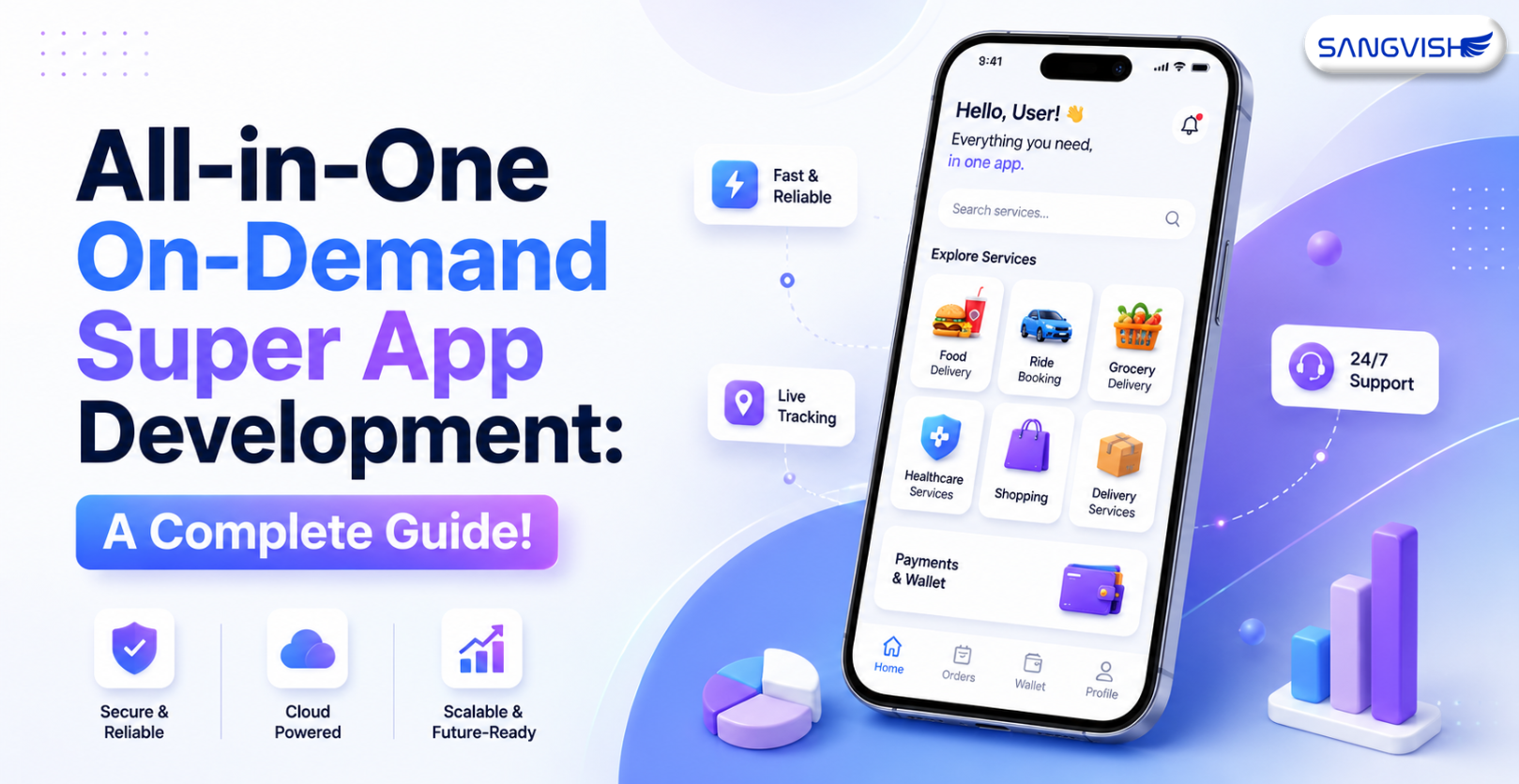
The way people use everyday services is in rapid change. Instead of individually downloading food and transportation apps, grocery shopping apps, home service and payment apps, and shopping apps, users are becoming more interested in having a single app that combines all these features. As demand continues to surge, all-in-one on-demand super app development has emerged as a promising venture for enterprises aiming to build a scalable digital ecosystem.
An on-demand super app packs several services, payment methods, user accounts, and personal experiences into a single app. It can generate new revenue streams and enhance customer engagement and retention for entrepreneurs and enterprises.
Table of Content
1. What Is an All-in-One On-Demand Super App?
2. Why Invest in Super App Development?
3. Essential Features of an On-Demand Super App
4. How Does an On-Demand Super App Work?
5. Technologies We Used
6. Super App Development Process
7. The Total Cost for Super App Development
8. Future of All-in-One On-Demand Super Apps
9. Build Your All-in-One On-Demand Super App
10. Conclusion
What Is an All-in-One On-Demand Super App?
An all-in-one on-demand super app is a multi-service, mobile application that enables the user to use multiple on-demand services via one application.
A super app can incorporate:
- Delivered food and groceries
- Taxi and transportation booking
- E-commerce and product delivery.
- Ecommerce and product delivery.
- Housekeeping and house cleaning services
- Medicine and healthcare delivery
- Beauty and wellness services
They work in the courier and logistics sector. They operate in courier/logistics.
- Digital wallets and online payments
- Any payments of bills and subscriptions.
Instead of having multiple separate applications, companies may come up with one unified ecosystem where users can discover, request, pay for, and track various services.
Why Invest in Super App Development?
A super app is the most convenient thing. Multiple needs can be addressed on one platform without having to switch between applications.
The advantages for businesses are much more than convenience.
Improved user retention: The more services the application offers, the more opportunity customers have to return to the app on a regular basis.
Revenue Generation: Businesses may generate revenues from various streams such as commission, service fees, subscriptions, advertising, delivery fees, premium memberships, partnerships, etc.
Customized suggestions: If one customer buys a service, another one similar to that service may be offered to him if it is suitable to his taste.
Reduced customer acquisition costs: Instead of promoting an array of apps, companies just need to raise awareness for one platform.
Unified customer data: With consent management and a privacy focus, it may even be used to deliver a more personalized experience and increase targeted promotions and service quality to existing customers through behavioral understanding.
Essential Features of an On-Demand Super App
More than just a combination of multiple services is needed to make a successful super app. It must have a stable and easy-to-use technology framework.
1. User Registration and Profiles
Registration should be quick and easy via email, telephone, and/or supported social login. Addresses, preferences, order history, payment options, and more can be stored in profiles.
2. Multi-Service Dashboard
The home screen should be made easy to use and have all services available at one click. Users can easily find the stuff they need in the categories, search, recommendations, banners, and location-based services.
3. Advanced Search and Filters
A strong search functionality enables users to find products, services, restaurants, providers, or delivery options easily. Filters can be tailored to the type of service.
4. Secure Payments
A super app should accept various forms of payment, including cards, bank transfers, digital wallets, and locally accepted payment methods. Robust security protocols are crucial to safeguarding transactions and customer data.
5. Real-Time Tracking
Real-time order or driver tracking can enhance the customer experience, particularly in the transportation, food delivery, grocery delivery, and logistics sectors.
6. Ratings and Reviews
Reviews and ratings enable customers to make informed decisions and also help companies and service providers to get feedback.
7. Push notifications
Push notifications can be used to update customers about anything: orders, promotions, payment receipts, order delivery status, as well as individual promotions or offers can also be pushed.
If pushed at the wrong times, these can often irate the customer, so they should be judiciously used by businesses.
8. Rewards and loyalty
Reward customers with loyalty points, cashback, memberships/referrals, exclusive offers and promotions in return for purchase or interaction and boost customer lifetime value, repeat purchase and retention.
9. AI-Powered Personalization
AI can analyse customer interactions and deliver personalised recommendations, promotions, intelligence search, and even automated support.
How Does an On-Demand Super App Work?
Generally, a super app brings together different groups of users via a common technology framework.
The customer app enables them to browse the services, make orders, make payments, and monitor transactions.
The service provider or vendor app allows restaurants, stores, drivers, technicians, delivery partners, and other service providers to process orders and manage availability.
The delivery or partner application is a useful one to be leveraged in Logistics, route management, job assignment, and real-time status updating.
The entire suite is governed by the admin panel for entrepreneurs to manage users, vendors, services, payments, commission, promotion, analytics, and customer support, from one single dashboard.
These all talk to each other behind the scenes via API and cloud infrastructure, providing a seamless experience.
Technologies We Used
These entire systems converse with each other behind the curtain in an API and cloud infrastructure to enable a smooth operation, and each super app has an appropriate technology stack. A super app technology stack depends on the scope of the project, budget constraints, scalability and platforms concerned, but is likely to include:
Web development: HTML, CSS and JavaScript. The creation of websites and apps.
Frontend: React, Angular or some other modern framework
Frontend: HTML5, CSS3, JavaScript and other modern web development tools
Database: Postgres, MySQL, MongoDB or similar
Cloud infrastructure: AWS, Microsoft Azure, Google cloud or something else
API’s: REST / GraphQL API’s connecting systems
For a large-scale super app, a modular architecture is particularly important. Individual services can be developed and scaled independently while remaining part of the same ecosystem.
Super App Development Process
Super App Development Process: Building a super app isn’t about shoving more and more impossible products together.
Define the Business Model: Determine target audience, geographical market, type of services, business model, and the competitive advantage.
Select Core Services: Start with the services you can provide that are solving real customer problems.
To test and predict demand with smaller-scale investments, it’s often useful to target with a focused MVP.
Create user experience: In the creation of a complex app, even a basic navigational layout and framework is needed. Users should easily find the service in a few taps.
Develop the MVP: Create the basic customer, provider, delivery, transaction management functionalities and capabilities, and administration.
Integrate third-party services: Connect various technologies including messaging services, analytics services, mapping capabilities, and payment features.
Test and Deploy: The final phase includes functionality, security, load and performance testing, as well as compatibility tests and user experience reviews.
Implement further automation, loyalty programs, personalization features, and advanced analytics capabilities based on real-time feedback from users.
The Total Cost for Super App Development
The development of an on-demand app is incredibly expensive, and the final cost depends on several factors, such as: the number of services integrated; the platform chosen; UI/UX complexity; the number of third-party integrations; development country; used technologies; data security measures to be taken into account; and maintenance following the launch.
How Much Does Super App Development Cost?
At the end of the day, what organizations should be thinking about isn’t the cost of developing a price tag, but total ownership costs (cloud, Integrations, security, Sales, Customer Success, ongoing feature development).
These are: Number of services, included platforms, UI / UX features, number of integrations, geographic origin for development, technology stack
Security requirements & data compliance Required post- launch updates & maintenance
Creating a rich, well-developed super app ecosystem with a good amount of service line and big audience is going to be very expensive. These include:
Number of services, platforms included, UI/UX features, number of integrations
Development geographic location technology stack Security and data compliance needs
Future updates and maintenance. A well-designed super app ecosystem with multiple service lines and a large user base will cost significantly more to develop than an MVP version with several services.
Monetization Strategies
Monetization Strategies When operating a super app, there is a variety of business models available to take advantage of:
Commissions from every transaction
Loyalty/subscription program for members Special premium offers from service providers
Charges for sellers per listing Payment/delivery/service advertisements in strategic locations
Commission based on partners’ transactions Fees from a financial service partnership
Commission on loyalty programs A varied mix of revenue models may not depend on a single source.
Future of All-in-One On-Demand Super Apps
The future of super apps appears to be tightly woven into artificial intelligence, automation, digitised money, hyperlocal services, and highly personalized experiences.
The potential for analytics services to help businesses make more informed business decisions and forecast consumer preferences will be crucial in how super apps function in the future, and AI assistants will increasingly become essential tools for everyday tasks.
However, a truly successful super app won’t be defined simply by the quantity of services it integrates.
Build Your All-in-One On-Demand Super App
Instead, it will be characterised by its seamless integration capabilities, its high standards of service quality, and its powerful safety and security features. Build your very own anytime, anywhere Super App.
Building an all-in-one super app like this one will allow you to strengthen customer bonds and help increase overall market share by enabling you to broaden the spectrum of your services and deliver services such as transportation, lodging, e-commerce, cleaning, delivery, payment systems, and many others within one platform.
Conclusion
In conclusion, if you plan to invest in a truly effective All-In-One On-Demand Super App solution, right now is a particularly advantageous time to invest in a scalable and robust digital solution. For a successful outcome, it’s advised to select and partner with an experienced super app development team that can identify the most appropriate business model, select the optimal technological stack, design and build a user-friendly platform, implement the necessary features and services, and prepare for sustained long-term growth.
Start your own journey to creating a new generation on-demand super app by designing and developing a truly customer-centric, interconnected and unified ecosystem of on-demand services today!

You may also like
Why the Gojek Clone Script Is the Future of Multi-Service Apps in 2025
Why the Gojek Clone Script Is the Future of Multi-Service Apps in 2025
In a world dominated by comfort and speed, customers are growing expect to satisfying all...