


Cart 0
The video streaming sector has become one of the most influential within the digital sector, changing how content is consumed, shared, and found online, including through YouTube. Viewing sessions on video sites range from billions to trillions per day, depending on whether people are viewing educational tutorials, product reviews, entertainment, or live broadcasts.
The interface doesn’t suffice for companies planning to create a video streaming platform, say like YouTube. However, developing a successful platform depends on having a scalable technology stack, efficient video processing, powerful search and recommendation capabilities, a secure infrastructure, and a sustainable business model that can drive growth in the long term.
In this guide, we’ll discuss the key steps required to create a video streaming platform similar to YouTube.
Define Your Target Audience and Business Model
Identify what your platform will offer and who will utilize it prior to choosing technologies. It can be costly to try to bite off a lot more than you can chew by trying to compete with YouTube in all categories from the ground up.
Rather, try to narrow down your niche to one like education, fitness, gaming, corporate training, entertainment, and regional content.
It is also important to ascertain how you will monetize your blog. Common options include:
- Advertising
- Premium subscriptions
- Pay-per-view content
- Creator memberships
- Sponsored content
- Transaction fees
- Freemium plans
The features, infrastructure, and priorities of the platform will vary based on the types of users and the kind of business model you have.
Plan the Essential Features
A YouTube-like platform typically has three major user groups: viewers, content creators, and administrators.
For viewers, essential features include user registration, personalized profiles, video search, categories, playlists, watch history, likes, comments, sharing, subscriptions, and personalized recommendations.
Creators need tools for uploading videos, managing channels, adding titles and descriptions, creating thumbnails, monitoring analytics, and managing comments. If monetization is part of your strategy, creators may also need dashboards showing revenue and advertising performance.
Administrators require a separate management system for moderating content, managing users, handling reports, monitoring platform performance, and managing monetization.
Build a Scalable Video Upload and Processing System
Video files are significantly larger than typical website assets, making video processing one of the most important technical components.
When a creator uploads a video, the platform should not simply store the original file and stream it directly. Instead, the video should pass through a processing pipeline.
A typical workflow is:
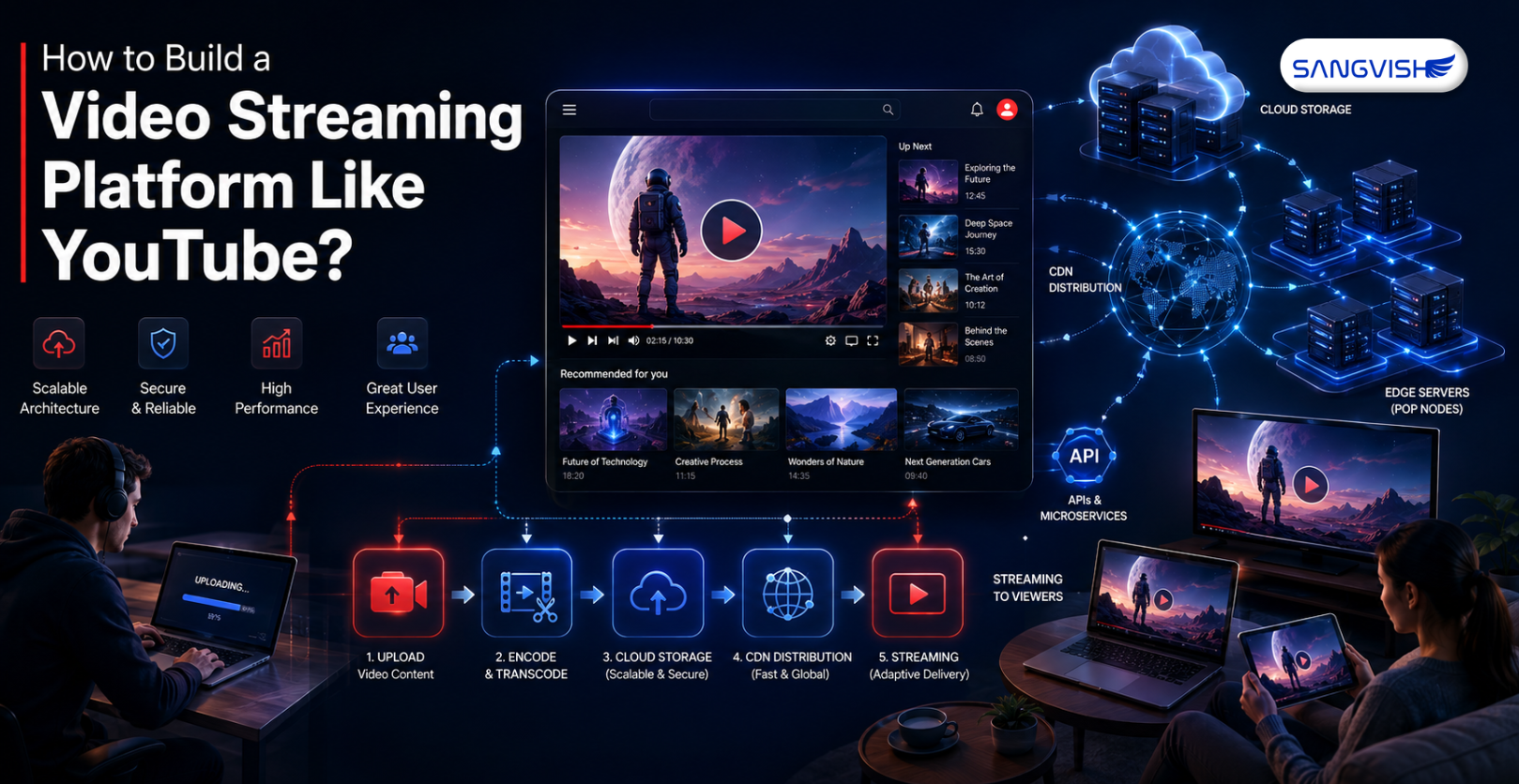
Upload → Storage → Transcoding → Quality Optimization → Thumbnail Generation → Content Delivery → Playback
The original video can be stored in cloud object storage. A transcoding service can then convert it into multiple resolutions and formats, such as 360p, 480p, 720p, 1080p, and higher resolutions.
Creating multiple versions allows the player to automatically select an appropriate quality based on the viewer’s internet connection and device.
Use Adaptive Video Streaming
A modern streaming platform should support adaptive bitrate streaming. Technologies such as HTTP Live Streaming (HLS) and MPEG-DASH divide videos into small segments that can be delivered according to network conditions.
For example, a viewer watching a video on a weak mobile connection may automatically receive a lower-resolution stream. When the connection improves, the player can switch to higher quality.
This approach reduces buffering and creates a smoother viewing experience.
Choose a Scalable Technology Stack
The technology stack should be selected according to your expected traffic, budget, development expertise, and scalability requirements.
A possible architecture could include:
- Frontend: React, Next.js, or another modern web framework
- Mobile: Flutter, React Native, or native Android/iOS development
- Backend: Node.js, Python, Java, Go, or similar technologies
- Database: PostgreSQL, MySQL, MongoDB, or a combination
- Caching: Redis
- Object storage: Cloud-based storage for video files
- CDN: A content delivery network for distributing video efficiently
- Search: Elasticsearch, OpenSearch, or another search engine
- Message queues: Kafka, RabbitMQ, or cloud-based queue services
For a large-scale platform, a modular or microservices-based architecture can help individual components scale independently. So Sangvish provides a best solutions to scale your video streaming platform.
Implement a Content Delivery Network
Streaming videos directly from one central server could lead to a poor video experience and high bandwidth costs. A CDN would store or cache video content on distributed, geographically located servers, allowing users to download videos from the locations closest to them.
A CDN would be especially useful for your platform as you plan to grow internationally.
Your architecture would normally keep your original and processed video content in scalable storage and use the CDN to provide video segments to your users.
Add Search and Recommendation Features
What makes YouTube valuable is not only its video playback functionality. The discovery feature allows users to find the videos that they want to watch.
Your video platform needs a solid search engine that supports searching by keywords, categories, titles, descriptions, tags, and authors.
Depending on how your platform grows, you could implement recommendation algorithms using such signals as:
- Viewing history
- Search history
- Likes/Dislikes
- Subscriptions
- Viewing completion rate
- Session behavior
- Categories
- Viewing history of similar users
Machine learning algorithms would eventually allow making recommendations more personalized, but initially you need a rule-based recommendation algorithm.
Prioritize Security and Content Moderation
Your platform, which is supposed to allow users to upload videos, needs to take care of security and moderation issues.
Such measures as:
- Encrypted connection
- Authentication
- Role-Based Access Control
- Rate limiting
- Secure APIs
- Anti-malware
- Security tests
would allow ensuring the security of your users’ accounts and protection against any harmful activity.
At the same time, you need to implement moderation of potentially harmful or illegal content on the platform.
It means that you should allow users to report videos and comments and allow admins to check the reports and ensure compliance with community guidelines.
Automated moderation and machine learning algorithms could later supplement manual moderation.
Roll Out MVP before Scaling
Development of all features at once can lead to increased time and financial costs for implementation. To avoid this, one should roll out a minimum viable product which includes only core functionalities.
The first version may contain the following features:
- User registration and profiles
- Uploading videos
- Processing videos
- Playing videos
- Searching
- Channels and subscriptions
- Likes and comments
- Basic administration
- Basic analytics
Then, based on user feedback and performance, it is possible to roll out advanced recommendations, live streaming, monetization of creators, applications for mobiles and desktops, AI-powered moderation and other features.
How Much Does It Cost to Build a YouTube-Like Platform?
The price largely depends on the complexity of the platform, location of development, number of applications required, infrastructure, and third-party services used.
An MVP can cost much less than a scalable solution which will be able to work with millions of users. Also, there can be additional costs related to video storage, transcoding, CDN traffic, database infrastructure, moderation, etc.
This means that it is necessary to consider not only initial development costs but also operating and infrastructure costs.
Conclusion
In Conclusion, the creation of a video streaming platform like YouTube involves not only software development but also cloud infrastructure, video engineering, security, content moderation, analytics and UI/UX design.
The best approach to it is starting with a particular niche and MVP rather than building a clone of YouTube from the very beginning. After getting product-market fit, you will be able to scale up the platform and add advanced features such as AI recommendations, live streaming, creator monetization, and many others.

You may also like
How to Establish a Revenue-Generating Business with a YouTube Clone Website
How to Establish a Revenue-Generating Business with a YouTube Clone Website
The growth of video content has altered the digital environment, creating several chances for entrepreneurs...