

Cart 0
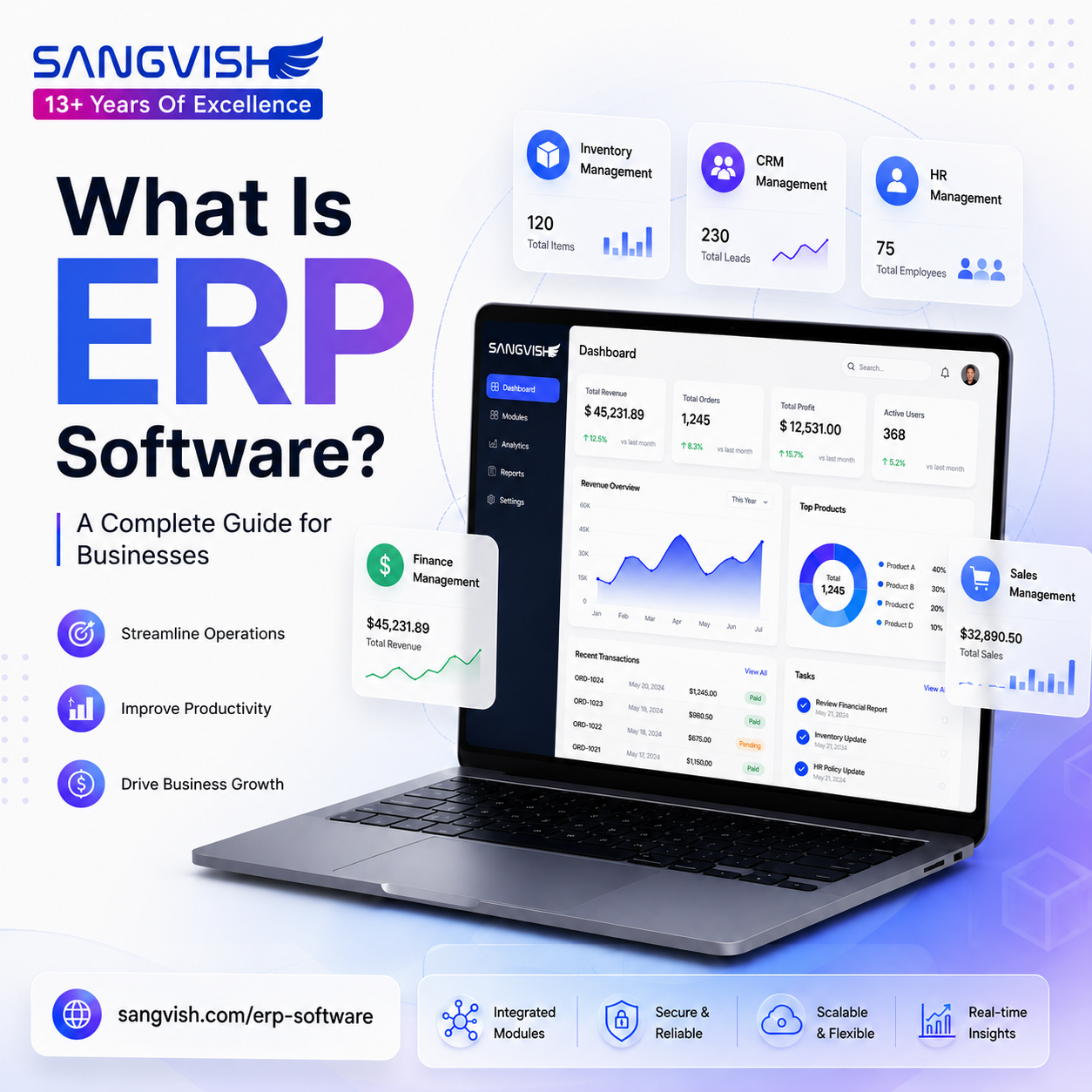
Every growing business eventually reaches a point where separate spreadsheets, disconnected tools, and manual processes stop being manageable. Finance runs on one system, inventory on another, and HR records sit somewhere else entirely. The result is duplicated effort, delayed reporting, and decisions made on outdated information. This is precisely the gap that ERP software was designed to close.
This guide walks through what it really does, how it works behind the scenes, the features that matter most, and which industries lean on it day to day. We’re also going to see where Sangvish ERP fits into all of this, and what you should keep in mind before picking a system for your own organization.
What Is ERP Software?
ERP stands for Enterprise Resource Planning. At its core, it is business management software that brings departments such as finance, inventory, sales, and HR into a single, connected system rather than leaving each to operate independently.
Consider how most businesses function before adopting a unified platform: accounting in one tool, stock levels in a spreadsheet, customer records in someone’s inbox — not through poor planning, but because it accumulates as a business grows.
An ERP setup fixes it, because every department gets the same real-time data. Take a retail business that sells online as well as in-store, for instance; without a connected system keeping stock really accurate across the channels is a pain to handle manually, but when enterprise resource planning software is in place, one single transaction updates the inventory and the financial statements at the same time.
How Does ERP Software Work?
The underlying structure feels more straightforward than the terminology implies. This system keeps one central database which, every department reads from and writes to, not each team running their own separate, isolated records.
In practical terms, the process generally follows this sequence:
- Data entry – Sales, purchases, inventory movements, and HR records are logged into the system as transactions occur.
- Centralized storage – This information is stored in one location, with access governed by user permissions.
- Automation – Recurring tasks such as invoicing, payroll processing, and stock alerts are handled automatically.
- Reporting – Management can view dashboards that reflect current activity rather than figures compiled after the fact.
The practical benefit shows up fast, in the way departments bounce off each other. When a sale is wrapped up, finance sees the invoice right away and the warehouse team has the same relevant data already to ship or fulfill, no extra back-and-forth between groups. It’s that alignment that an ERP system, is designed to bring together, so everything stays in step.
Key Features of ERP Software
Not every platform offers an identical set of tools, but dependable business management software typically includes the following:
- Inventory Management – Accurate stock tracking across locations, reducing the risk of shortages or overstocking.
- Accounting & Finance – Invoicing, expense tracking, and budgeting managed from a single interface.
- Human Resource Management – Payroll, attendance, and employee records maintained without a separate system.
- Customer Relationship Management (CRM) – A consolidated record of leads and customer interactions.
- Sales & Purchase Management – Order processing, quotations, and vendor coordination in one workflow.
- Reporting & Analytics – Real-time insights that support informed decision-making.
- Cloud Accessibility – Secure access from any location, on any authorized device.
Sangvish ERP brings these capabilities together within a single platform, removing the need to manage multiple disconnected tools. A more detailed breakdown is available on the ERP software page.
Benefits of ERP Software
The value of adopting an ERP solution becomes evident once its impact is measured across the organization. Common benefits include:
- Increased productivity – Automating routine tasks allows teams to focus on higher-value work.
- Better decision-making – Leadership gains an accurate, real-time view of operations rather than relying on outdated figures.
- Reduced operational costs – Fewer manual errors and less duplicated effort translate into measurable savings.
- Improved collaboration – Shared data reduces miscommunication between departments.
- Real-time reporting – Performance can be reviewed as it happens, rather than waiting until month-end.
- Scalability – A well-built ERP solution expands as the business adds locations, staff, or product lines.
- Better customer service – Staff can access order history instantly, enabling faster and more accurate responses.
Collectively, these advantages explain why Enterprise resource planning software has become standard practice for growing businesses rather than a resource reserved for large enterprises alone.
Industries That Use ERP Software
This category of platform is not confined to a single sector. It is used across a wide range of industries, including:
- Manufacturing – Production scheduling, raw material tracking, and quality control.
- Retail – Inventory synchronization across online and physical stores.
- Healthcare – Patient records, billing, and supply chain management.
- Logistics – Shipment tracking, fleet management, and warehousing.
- Education – Admissions, staff records, and institutional finance.
- Construction – Project costs, materials, and scheduling.
- Wholesale Distribution – Bulk order processing and supplier coordination.
- Service Businesses – Client billing, scheduling, and resource allocation.
Regardless of sector, a properly configured ERP solution can be tailored to match specific operational requirements.
Why Choose Sangvish ERP?
With numerous platforms available, selecting the right one requires careful evaluation. This is where Sangvish distinguishes itself from other providers.
Sangvish, an ERP SaaS platform is designed to help businesses of every size manage their operations through a system that is secure, scalable, and genuinely customizable, rather than one that requires the business to adapt to rigid software constraints.
Several factors set Sangvish apart:
- Customization – Modules are configured to match existing business processes rather than imposing a fixed structure.
- Scalability – Whether the business is a small operation or an expanding enterprise, Sangvish grows in line with its requirements.
- Security – Data is protected through established security protocols and controlled access.
- Cloud accessibility – Teams can work from any location, whether in-office or remote.
- Dedicated support – The Sangvish team remains available for setup, training, and ongoing assistance.
When businesses are looking at their options, it’s a good idea to take a look at the ERP Modules page, to see how Sangvish ERP SaaS actually lines up with their own particular needs.
Tips for Choosing the Right ERP Software
Selecting an ERP system is a significant decision, and a structured evaluation reduces the risk of a costly mismatch. Consider the following factors:
- Business size – A small operation and a large enterprise typically require different configurations.
- Industry requirements – Prioritize modules relevant to the specific sector rather than generic functionality.
- Budget – Account for ongoing subscription and maintenance costs, not only the initial investment.
- Customization – The ERP solution selected should adapt to the business, not the reverse.
- Scalability – Choose a system capable of supporting future growth rather than one likely to be outgrown quickly.
- Support and training – Reliable support directly affects how smoothly implementation proceeds.
- Cloud vs on-premise – Determine which deployment model best suits the organization’s operational needs.
Key Takeaways
ERP software has become a practical necessity for businesses seeking to remain organized, efficient, and competitive. By consolidating finance, inventory, HR, and sales into a single platform, organizations can make faster decisions, control costs, and reduce operational risk.
Whether evaluating a first business management software or upgrading from an existing system, choosing the right ERP solution has a direct impact on long-term operational efficiency. Sangvish ERP SaaS was built specifically to support this transition, offering the security, flexibility, and support that growing businesses require.
Ready to Transform Your Business?
Discover how Sangvish ERP helps you manage finance, inventory, HR, CRM, and sales from one powerful platform. Request a free demo today and experience smarter business management.
Frequently Asked Questions